Unit 1 — Data
What you will learn
- The difference between data, information and knowledge — and why the computer only sees the first one
- How Shannon made information something you can measure (in bits)
- Why a "300 Mbps" line is not 300 MB/s (the ÷8 trap)
- How Huffman coding squeezes BANANA from 48 bits to 9 — and why the receiver never gets confused
- Why compression = prediction — and what that has to do with ChatGPT
What is information?
Everything a computer does — storing, transforming, transferring (see Hardware) — is done to one thing: information. But what is it?
- Information is anything that has a meaning to us
- Or might lead us to a meaning
"Information is the reduction of uncertainty" — Claude Shannon
Information ≈ Data
Careful: data and information are not exactly the same thing.
- Data = the raw symbols (a
0, a letter, a number...) - Information = data with meaning
The same data can mean very different things — the meaning is ours, not the computer's:
24/05— a date? a score? a code?C/Cóndor, 9, 07181— an address? a licence plate? a password?971 230 470— a phone number? a lottery ticket?
Data becomes information when we give it context. And information becomes knowledge when we connect it with what we already know and use it to make decisions.
Information can be:
- Numeric (1, 2, 3, ...)
- Alphabetic (A, B, ... Z)
- Alphanumeric (letters, digits and symbols mixed — note that you can't do math on them:
A1is text, not a number) - Others (CR, LF, ...)
The computer never knows
To the machine, 24/05, a birthday and a football score are just bytes. The meaning only exists in the head of the person reading them. Computers are messengers, not minds.
Shannon's mathematics of information
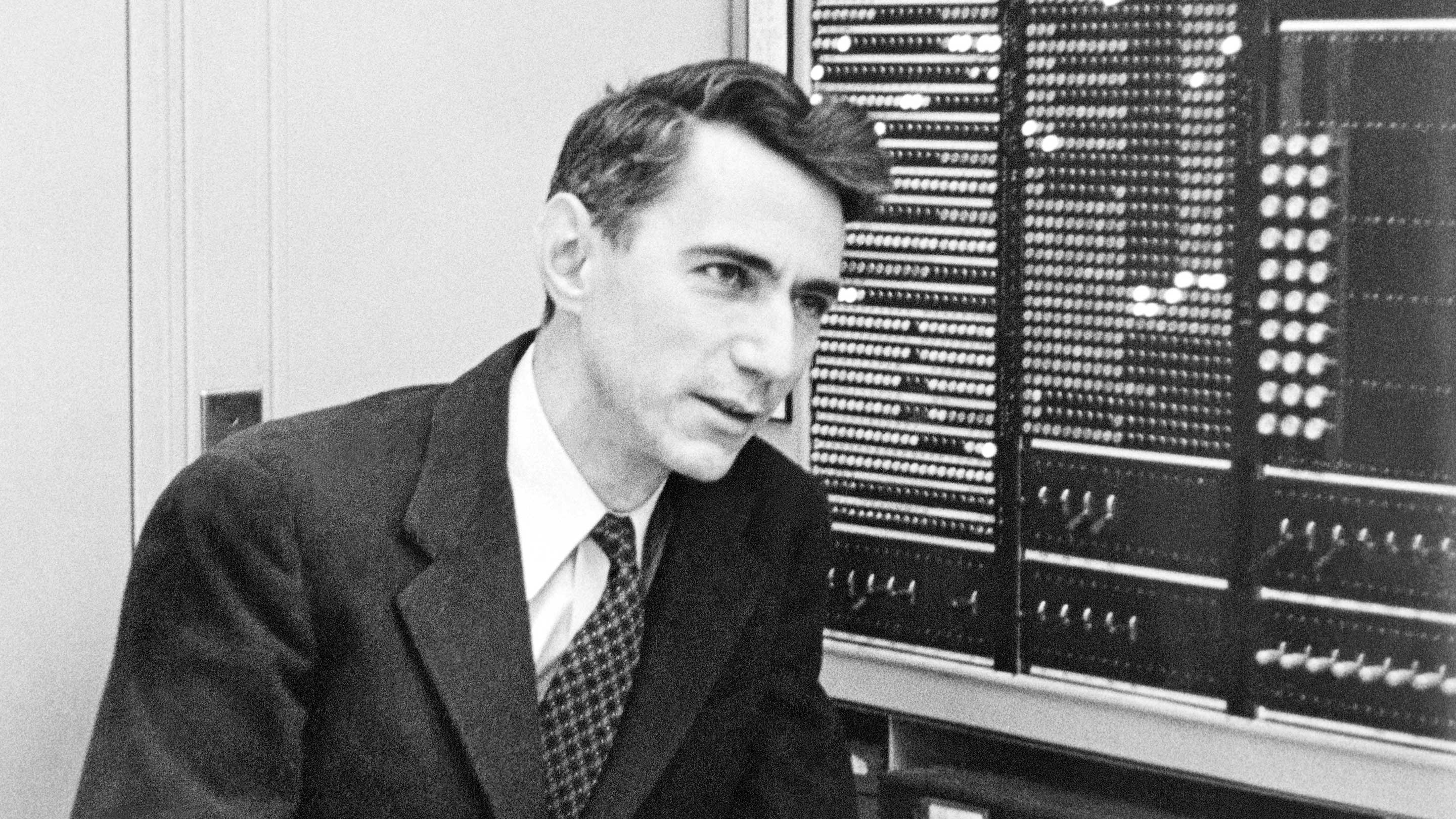
In 1948, an engineer at Bell Labs named Claude Shannon published a paper with a modest title — A Mathematical Theory of Communication — and quietly invented the digital age. He asked a question nobody had asked precisely before:
How much information does a message actually contain — and what is the least I need to send it?
No formulas here, just the ideas:
Information = surprise
Shannon's core insight: the information in a message is how much uncertainty it removes.
- "The sun rose this morning." → You already knew it. Zero information.
- "Tomorrow's exam is cancelled." → You didn't know that. Lots of information.
The more surprising the message, the more information it carries. Rare events are informative; obvious events are not.
The 20-questions game
Think of 20 questions: each yes/no answer splits the possibilities in half. Twenty good questions are enough to pinpoint one thing among about a million. Shannon's move was to say: measure information in yes/no questions — in bits — not in meaning, importance or length.
Entropy: average surprise
A source of messages (a person, a sensor, a file) has an average level of surprise. Shannon called this entropy:
- A fair coin flip is maximally unpredictable → maximum information for its size.
- A weighted coin (99% heads) is boring → each flip tells you little.
- A source that always says the same thing carries zero information — you can skip it entirely.
Entropy is why some files shrink and others don't: a file that repeats itself a lot has low entropy and is easy to compress; a file that looks like random noise has high entropy and resists compression.
Language is redundant — on purpose
Try reading this: Ths sntnc hs n vwls. You could, right?
Natural languages carry far more symbols than strictly needed: predictable letters, grammar that lets you fix typos, repeated phrases. Shannon measured it — English is roughly 75% redundant: delete most letters and a good reader still reconstructs the message.
That redundancy is not waste. It is protection against noise: it is why you can chat in a loud room, why scratched DVDs still play, and why your Wi-Fi works through walls. Shannon showed there is a precise trade-off: redundancy can be spent to fight errors.
Key idea
Shannon separated the engineering side of information (how many bits, how fast, how reliably) from its meaning. A random string scores high in "surprise" yet means nothing. Meaning stays with us — but bits, compression and error correction became mathematics.
Huffman: short codes for common symbols
Shannon told us how few bits a message could need. He did not give a practical recipe to get there. That came in 1952, from a student.
David Huffman was a graduate student at MIT. His professor, Robert Fano, offered the class a choice: sit the final exam, or write a term paper on finding the most efficient binary code. Huffman picked the paper, struggled for months, and was about to give up and study for the exam — when he found the answer. His method beat the one his own professor had been working on.
The idea is one you already know from Morse code: the most common letter in English, E, is a single dot, while a rare letter like Q is – – · –. Huffman made that exact:
Huffman coding: give the shortest codes to the most frequent symbols and the longest codes to the rarest ones.
Take the word BANANA. ASCII spends 8 bits per letter, whatever the letter: 6 × 8 = 48 bits. But the letters are not equally common:
| Letter | Times it appears | Huffman code |
|---|---|---|
| A | 3 | 0 |
| N | 2 | 10 |
| B | 1 | 11 |
The recipe to build the codes: take the two rarest symbols and join them into one group; repeat until everything is joined. Each join is a fork in a tree: going left writes a 0, going right writes a 1.
flowchart TB
    ROOT(["<b>BANANA</b><br>6 letters"]) -->|"0"| A["<b>A</b><br>3 times<br>code 0"]
    ROOT -->|"1"| NB(["<b>N + B</b><br>3 times"])
    NB -->|"0"| N["<b>N</b><br>2 times<br>code 10"]
    NB -->|"1"| B["<b>B</b><br>1 time<br>code 11"]
Now encode it:
Same word, less than a fifth of the bits. And nothing is lost: the receiver gets back exactly BANANA. This is lossless compression — the opposite of lossy compression (JPEG, video streaming), which throws away detail you hopefully won't miss.
The prefix rule: no separators needed
Wait. The bit stream 110100100 has no spaces. How does the receiver know where one letter ends?
Look at the codes again: 0, 10, 11. No code is the beginning of another one. This is the prefix rule, and Huffman's tree guarantees it, because every letter sits at the end of its own branch. So the receiver reads bit by bit, and the moment the bits match a code, that letter is done.
Careful: without the prefix rule, it breaks
Imagine the codes were A → 0, N → 1, B → 01. The stream 01 could be B... or A then N. The receiver cannot tell. A code that breaks the prefix rule is useless without separators — and separators cost bits.
Your turn: play the receiver
Using the BANANA code (A → 0, N → 10, B → 11), decode this stream:
Read bit by bit: 1 alone is not a code, so take 10 = N; then 0 = A; then 1 is not a code, so take 11 = B; then 0 = A; then 0 = A.
Result: NABAA — 7 bits instead of the 40 that ASCII would need, and no separators were necessary: the prefix rule did the splitting for you.
Huffman coding is still everywhere, 70 years later: it is one of the stages inside ZIP, PNG, JPEG and MP3 files.
The deep part: prediction
Here is where Shannon's entropy meets Huffman. The best possible code length for a symbol depends on how predictable it is:
- If you can guess the next symbol almost surely, it costs almost nothing to encode — just note "no surprise".
- If the next symbol is a total shock, it costs a lot.
Flip that statement around and you get the central idea of this section:
Key idea
Compression = prediction. To compress data, you build a model of it and use it to guess what comes next. You only spend bits on what the model fails to predict — the surprise. Every bit saved is a correct guess.
Modern compressors are built exactly like this:
- ZIP keeps a sliding window of recent data and encodes "repeat what appeared 50 bytes ago" instead of the bytes themselves.
- PNG tries to predict each pixel from its neighbours and encodes only the difference.
- Video codecs predict each frame from the previous one and encode only what changed — which is why a video of a static scene is tiny and a confetti storm is huge.
In every case: the better the model predicts, the fewer bits are needed. A perfect predictor compresses to almost nothing.
And AI? A language model is a compressor
Now connect the dots. What does an LLM (a system like ChatGPT) train to do?
Given all the text so far, predict the next word (more precisely, the next token).
That is literally the objective of a compressor — guess the next symbol, only encode the surprise. The difference is the model:
| Huffman (1952) | LLM (today) | |
|---|---|---|
| Model of the data | Letter frequencies | Grammar, facts, style, world knowledge, reasoning patterns |
Prediction of The cat sat on the ___ |
Can't predict words | Predicts mat |
| Compression of English text | ~2–4 bits per character | Under 1 bit per character |
Train a language model, then use it as a compressor: it beats ZIP on text by a huge margin. And it must understand something about the content to do it — you cannot predict "mat" without some notion of how cats, sitting and sentences work.
The Hutter Prize
There is an actual competition, the Hutter Prize, built on this idea: compress a chunk of Wikipedia as much as possible. Why? Because compressing human text well requires understanding language — so compression ratio is a measurable proxy for intelligence. The better you compress, the better you predict; the better you predict, the more you understand.
So the chain is:
more predictable data → more compressible
better model → better predictions → better compression
best known text predictors → AI language models
One caveat to keep us honest: an LLM is a lossy compressor of the internet — it keeps the patterns, not the exact pages. Ask it for a quotation and it will give you something plausible, not necessarily something exact. Compression without the guarantee of getting back the original.
Key takeaways
- Data = raw symbols; information = data with meaning — and the meaning is added by us, never by the machine.
- Information = reduction of uncertainty (Shannon): surprise is measurable, and the unit is the bit.
- Computers speak binary because two states are impossible to confuse: cheap and reliable.
- 8 bits = 1 byte = 256 values = one ASCII character.
- Capacity is measured in bytes, speed in bits per second: divide by 8 before comparing.
- Huffman coding gives short codes to frequent symbols; the prefix rule means no separators are needed.
- Compression = prediction: pay bits only for the surprise. Huffman does it with letter frequencies; an LLM does it with a model of the whole world.
Quick check
Test yourself:
1. What is the difference between data and information?
- Data is raw symbols; information is data with meaning
- Data is measured in bytes, information in bits
- Data is stored by the computer, information is printed on paper
- They are the same thing under two names
Data = raw symbols (24/05). Information = data with meaning (a birthday). The meaning is added by us, never by the computer.
2. Why do computers use binary (2 states) instead of, say, 10?
- Two states are impossible to confuse, even with noise
- Binary numbers are shorter to write down
- The mathematicians who invented them preferred base 2
- Ten states would use more electricity per calculation
Two states (electricity vs. no electricity) cannot be confused, so the system stays reliable even with noise. Complex behaviour is built from many tiny yes/no decisions.
3. A 400 Mbps connection: what is the maximum download speed in MB/s?
- 50 MB/s
- 400 MB/s
- 3,200 MB/s
- 40 MB/s
400 ÷ 8 = 50 MB/s. Remember: capacity is measured in bytes, speed in bits per second — always divide by 8 before comparing.
4. Shannon: which message carries more information — 'the sun rose today' or 'tomorrow's exam is cancelled'?
- The exam news: it was surprising
- The sunrise: it is a bigger event
- The exam news: it contains more words
- Neither: both messages carry the same information
Information is the reduction of uncertainty: the sunrise was fully predictable (zero surprise), the cancellation was uncertain and surprising (high information). Rare events carry more information.
5. Why can a Huffman code compress text — and what guarantees it can be decoded?
- Frequent symbols get short codes, and no code starts another
- Unknown symbols are removed from the text
- Huffman adds a separator row between every two codes
- Frequent symbols get long codes so they are easier to see
Frequent symbols get short codes and rare ones get long codes (like Morse: E = one dot). It is decodable thanks to the prefix rule: no code is the beginning of another, so the receiver can split the bit stream without separators.
6. Why do we say compression = prediction? What does that have to do with AI?
- A compressor only stores what its model fails to predict
- Prediction removes the need to compress, because the model already has the data
- Huffman uses a neural network to guess the next letter
- AI can only compress text, not other information
A compressor encodes only what its model of the data fails to predict; every saved bit is a correct guess. An LLM trains to predict the next word, so a good language model is automatically a great compressor (and vice versa). Huffman is that idea with a tiny model (letter frequencies); an LLM is the same idea with a huge one.